If you already use Revolut, buying a travel eSIM directly through the Revolut app is an appealing option. There’s no need to create another account or download another app, and you can buy and manage your mobile data alongside the rest of your Revolut services.
But convenience isn’t everything. Revolut’s eSIM has some important differences compared with dedicated providers, including fixed-data-only plans, no calls or texts, and fewer clearly documented connectivity features.
In this Revolut eSIM review, we’ll look at how the service works, its plans and pricing, its main strengths and limitations, and how it compares with alternatives like Airalo, Saily, and Holafly.
For a broader look at the market, see our full eSIM comparison.
Contents
Revolut eSIM at a glance
Revolut’s eSIM is a travel data service built directly into the Revolut app. It offers fixed-data country, regional, and global plans, making it particularly convenient for existing Revolut users who want to buy and manage travel data without another app or account.
The strongest proposition is for Ultra subscribers, who receive 3GB of global eSIM data each month as part of their plan. For everyone else, convenience is the main attraction, while dedicated eSIM providers offer a broader range of plans and features.
How does Revolut eSIM work?
Buying a Revolut eSIM is straightforward. In the Revolut app, you can search for “eSIM” from the home screen to access the travel data section. From there, you can browse country, regional, and global plans and choose the data amount and validity period that suit your trip.
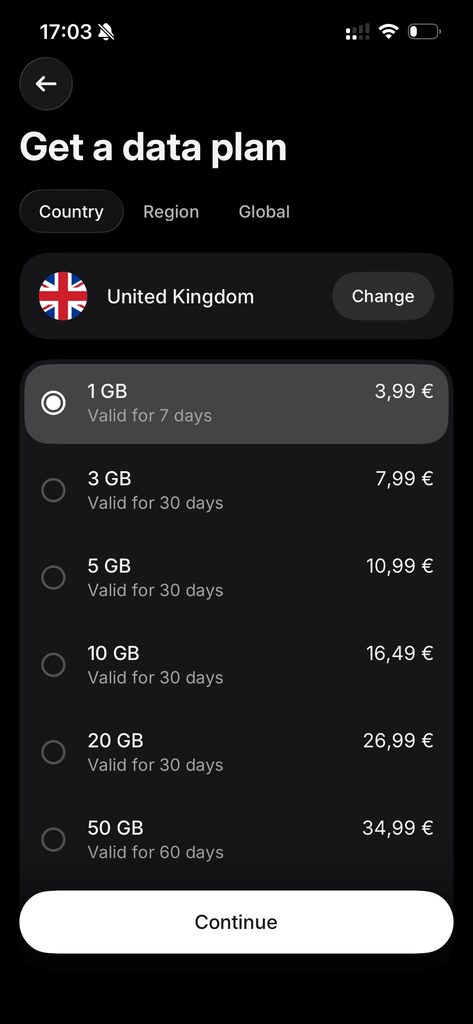
Once you’ve selected a plan, you can purchase it directly through the Revolut app. The coverage, data allowance, validity period, and price are displayed before you complete the purchase.
You can also enable auto-renew, which automatically repurchases the same plan if you run out of data before its validity period ends. Auto-renew expires after 90 days, four renewals, or when a plan period ends without you running out of data, whichever comes first. You can disable it at any time in the Revolut app.
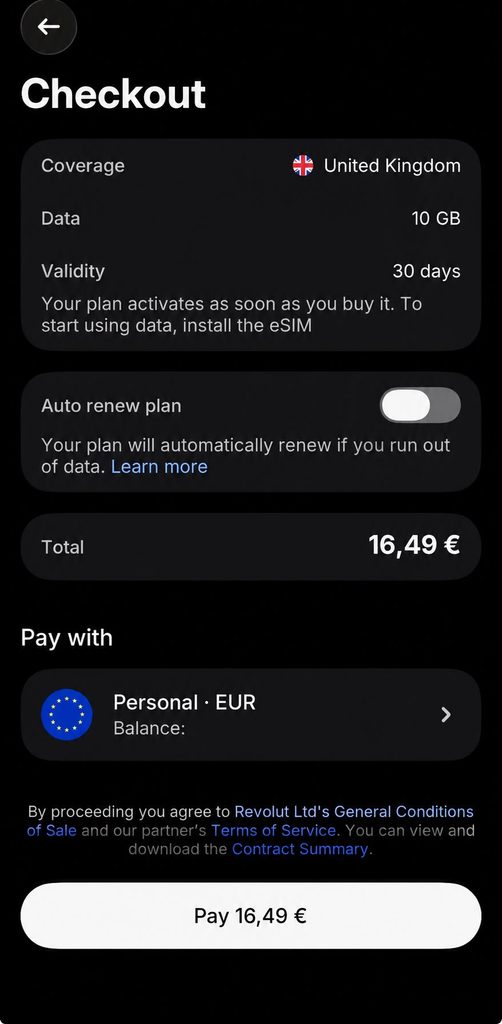
Revolut states that your plan activates as soon as you purchase it. To start using your data, you’ll then need to install the eSIM on your device. Once installed, the eSIM should connect automatically when you’re in a covered country with network coverage, provided your phone’s settings are configured correctly.
Before using it abroad, make sure your Revolut eSIM is selected for mobile data, and check that your regular SIM isn’t configured to use mobile data abroad. You can track your connection status and remaining data directly in the Revolut app.
Revolut eSIM plans and pricing
Revolut offers country, regional, and global eSIM plans, all of which come with a fixed data allowance. There are currently no unlimited-data plans, and the service is data-only, with no traditional calls or SMS included.
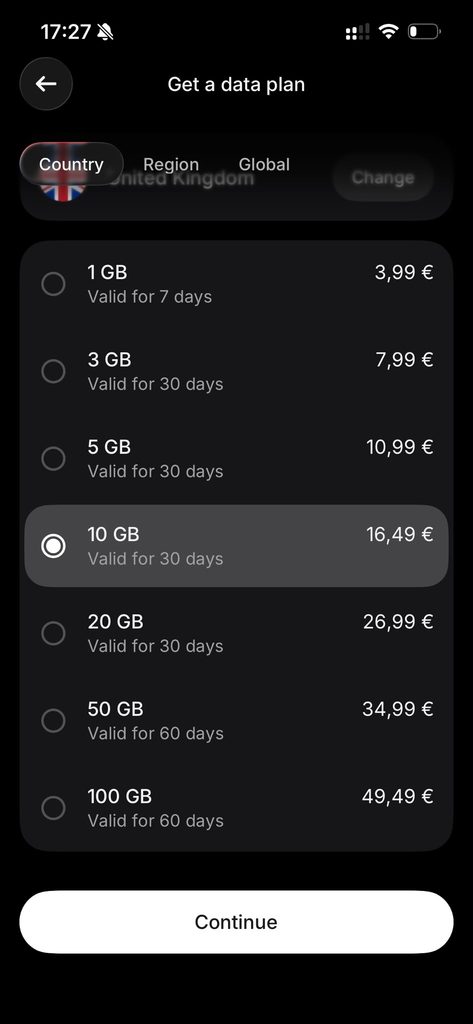
Data allowances range from 1 GB to 100 GB, with validity periods ranging from 7 to 60 days. The exact options and prices depend on your destination.
For example, at the time of writing, Revolut eSIM plans for travellers visiting the UK range from €3.99 for 1 GB valid for 7 days to €49.49 for 100 GB valid for 60 days. A 10 GB plan valid for 30 days costs €16.49.
Pricing can vary between destinations, so it’s worth checking the Revolut app for the exact price of your trip rather than assuming the same plan will cost the same everywhere.
Revolut Ultra customers also receive 3 GB of global eSIM data per month as part of their subscription. For other Revolut customers, eSIM plans are available as separate purchases through the app.
Overall, Revolut’s pricing is broadly in line with other major travel eSIM providers, so price alone is unlikely to be the main reason to choose it over a dedicated alternative.
What does Revolut eSIM do well?
Revolut’s main advantage isn’t lower prices or a significantly better selection of data plans. It’s convenience, particularly if you’re already using Revolut.
You can buy, install, and manage your eSIM without creating another account or downloading another app. Your remaining data and connection status are also available directly through Revolut, keeping everything in one place.
For Ultra customers, the included 3 GB of global data each month is another meaningful benefit. It could be enough for a short trip or light data use without purchasing a separate plan.
Revolut also offers a good range of fixed-data allowances, from 1 GB to 100 GB, making it relatively easy to choose a plan that matches your expected usage.
Auto-renew is another useful option if you’re worried about running out of data during your trip. When enabled, Revolut automatically renews your plan if you use your full data allowance before it expires, helping you stay connected without having to manually purchase another plan.
Where does Revolut eSIM fall short?
The biggest limitation is the lack of unlimited-data plans. Revolut only offers fixed-data allowances, while Airalo and Saily offer unlimited options across many popular destinations, and Holafly focuses entirely on unlimited plans. Travellers expecting heavy data use may therefore find these alternatives more suitable.
Revolut’s eSIM is also data-only, with no traditional calls or SMS. This is common among travel eSIMs, although some Airalo plans include calls and texts, while Saily offers an option with a US phone number.
There is also no traditional top-up system. If you run out of data, you can purchase another plan or use auto-renew rather than manually adding more data to your existing plan.
Finally, Revolut could be much clearer about some basic connectivity features. At the time of writing, we couldn’t find clear information about 5G availability or hotspot/tethering support in the Revolut app, on its website, or in the eSIM terms. Dedicated eSIM providers like Airalo, Holafly, and Saily make this information much easier to find.
Comparison with alternatives
Revolut’s eSIM is competitive with dedicated eSIM providers on price and basic travel data, but the main differences become clearer when you look at plan types and additional features.
Revolut vs Airalo
Airalo is probably the closest alternative to Revolut for travellers who prefer fixed-data plans. Both offer a wide range of data allowances at broadly similar prices, but Airalo also gives you access to a broader range of plan types.
Unlike Revolut, Airalo also offers unlimited-data plans across many popular destinations. In certain locations, such as the UK, you can also choose plans that combine a data allowance with call minutes and SMS, typically at a higher price than the equivalent data-only options.
Revolut has the advantage for existing users who value the convenience of managing their eSIM through an app they already use.
Revolut vs Holafly
Holafly takes a very different approach. Instead of fixed-data allowances, it focuses on unlimited-data plans, with durations that can be tailored closely to the length of your trip.
That makes Holafly more appealing if you expect to use a lot of mobile data and don’t want to monitor your remaining allowance. Revolut makes more sense if you prefer paying for a specific amount of data or simply value the convenience of keeping everything within Revolut.
Holafly generally allows you to share up to 1 GB of data per day via hotspot, while Revolut doesn’t clearly disclose its hotspot policy.
Revolut vs Saily
Saily offers both fixed and unlimited plans, making its overall plan selection more flexible than Revolut’s fixed-data-only approach. Its unlimited plans include 5 GB of full-speed data per day before speeds are reduced.
Its biggest differentiator is its additional security features, including ad blocking, web protection, and virtual location options. Saily also allows unlimited hotspot sharing, while Revolut doesn’t clearly document its tethering policy.
Revolut remains the simpler option for existing customers who don’t need those additional features and would rather buy and manage their travel data within the Revolut app.
For a more detailed comparison of the three dedicated providers, see our Airalo vs Holafly vs Saily comparison
Who is Revolut eSIM best for?
Revolut’s eSIM makes the most sense for existing Revolut users who value convenience. If you’re happy with a fixed-data plan, you can buy and manage your travel data through an app you already use, without creating another account or signing up with a dedicated eSIM provider.
It’s less compelling if you need unlimited data or want additional features offered by providers like Airalo, Holafly, or Saily. And if you don’t already use Revolut, there isn’t much about the eSIM itself that would justify opening an account solely to access it.
Ultra customers are a slightly different case. Since 3 GB of global eSIM data is already included with the subscription each month, it’s a useful benefit to take advantage of before paying for a separate travel eSIM.
Is Revolut eSIM worth it?
Yes, Revolut eSIM can be worth using, particularly if you already have a Revolut account. Its biggest advantage is convenience: prices are broadly in line with the market, there’s a good selection of fixed-data plans, and everything can be purchased and managed through the Revolut app.
However, there isn’t much about the eSIM itself that makes it clearly better than dedicated alternatives. Airalo, Holafly, and Saily offer a broader range of specialised options, including unlimited plans, calls and texts with some plans, and additional connectivity or security features that Revolut doesn’t currently provide.
If you already use Revolut and find a plan that suits your trip, there’s little reason not to consider it. But if you don’t have a Revolut account, we don’t think the eSIM offering alone provides a compelling reason to open one. Dedicated eSIM providers offer comparable pricing and a broader range of options without the additional step of becoming a Revolut customer.
For more help comparing providers or choosing a travel eSIM, explore our eSIM guides, reviews, and comparisons.
Leave a Reply