If you have a trip coming up, a travel eSIM can make staying connected abroad much easier. The harder part is deciding which provider to use, with dozens of options now offering different plans, prices and features.
Vodafone is an interesting addition to that market. Unlike most dedicated travel eSIM providers, it’s a major mobile network operator with an established international footprint. But does that actually make its travel eSIM a better choice?
In this Vodafone Travel eSIM review, we’ll look at how the service works, its plans and pricing, how it compares with alternatives such as Airalo, Saily, Holafly and Revolut, and who it makes the most sense for.
Contents
What is Vodafone Travel eSIM and how does it work?
Vodafone Travel eSIM is a prepaid service that lets you access mobile data abroad without relying on your regular carrier’s international roaming. You don’t need to be an existing Vodafone customer to use it.
The service covers more than 200 destinations, with country-specific and regional plans available. If you’re not familiar with travel eSIMs, our 10 Essential eSIM Questions Answered guide covers the basics of how eSIMs work.
After purchasing a plan, you can install the eSIM through Vodafone’s app, a one-click installation link, QR code, or manual setup.

Vodafone Travel eSIM is data-only, with no regular calls or SMS. The eSIM must be activated within 30 days of purchase and remains valid for 90 days after activation, although individual data plans have their own validity periods.
Vodafone Travel eSIM plans and pricing
Vodafone offers eSIM plans for individual countries as well as regions covering multiple destinations. Depending on where you’re travelling, you can choose between fixed-data and unlimited plans, with different plan lengths available.
Fixed plans range from smaller allowances for short trips to much larger packages. In popular destinations such as Spain and the UK, Vodafone offers plans with up to 100 GB of data, while unlimited plans are available for periods ranging from 7 to 30 days.
Here are a few examples of the prices available when we checked:
| Destination | Fixed-data example | Unlimited example |
| Spain | 40 GB / 30 days – €12.75 | 7 days – €16.15 |
| UK | 20 GB / 10 days – €11.90 | 7 days – €16.15 |
| Japan | 10 GB / 30 days – €11.90 | 7 days – €19.55 |
These prices included promotional discounts at the time of writing, so they shouldn’t be treated as Vodafone’s permanent rates. Prices and available plans also vary by destination, so check Vodafone’s current Travel eSIM plans and prices before choosing a plan.
How Vodafone’s unlimited plans work
Vodafone’s unlimited plans come with an important fair-use limit. In destinations including Spain, the UK and Japan, you get 5 GB of high-speed data per day. After using that allowance, you can continue using data at speeds of up to 5 Mbps for the rest of the day.
That means the plans are unlimited in terms of total data usage, but not unlimited at full speed. Fair-use terms can vary, so it’s worth checking the conditions for your specific destination before purchasing.
If you’re unsure which option makes more sense for your trip, our Unlimited vs Fixed Data eSIMs guide explains the trade-offs between the two.
Vodafone Travel Together
One of Vodafone’s most interesting features is Travel Together, which lets up to five travellers or devices share a single data plan.
The concept is simple: one person buys the plan, everyone shares the same pool of data, and each traveller gets their own data-only eSIM. This means everyone has an independent connection and can use their share of the data without staying close to another person’s phone.
For example, Vodafone currently offers a Europe Travel Together plan with 100 GB of shared data for 15 days across 42 countries.
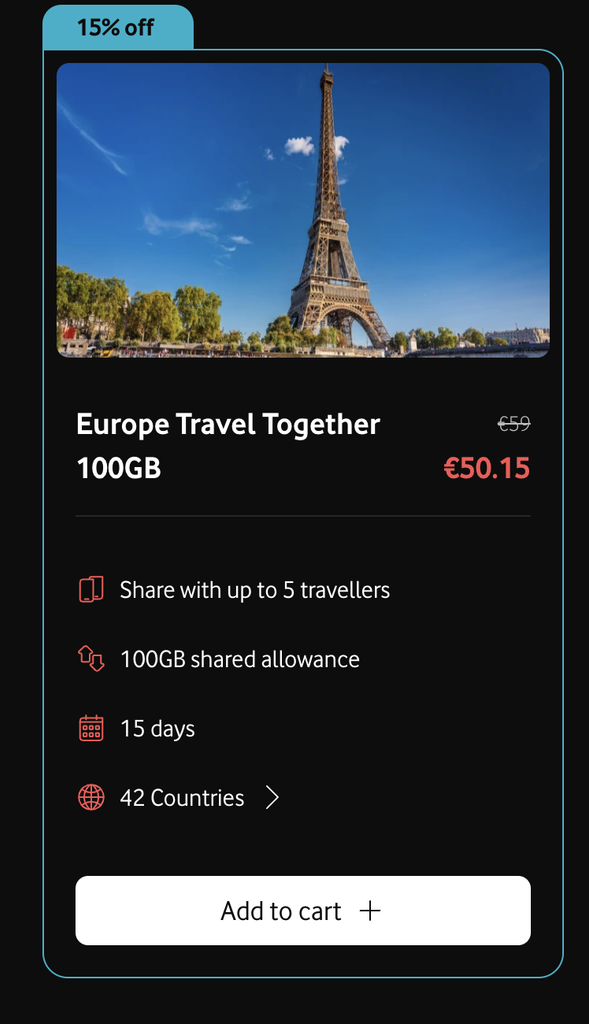
This makes Travel Together particularly useful for couples, families and groups who want one shared plan but still want to use their phones independently.
Travel Together supports 5G, and members can be added before or during the trip. If the group needs more data or additional days, only the plan owner, meaning the person who purchased the plan, can buy a top-up through the Vodafone Travel eSIM app.
One thing to watch is activation. The plan starts as soon as any one of the eSIMs is installed and connects to a supported network, so it’s worth coordinating installation with the rest of the group before your trip.
What does Vodafone Travel eSIM do well?
Vodafone Travel eSIM doesn’t necessarily offer dramatically different standard plans from competitors such as Airalo or Saily, but there are several things it gets right:
- Travel Together is a genuine differentiator. Up to five travellers can use independent eSIMs while sharing one data allowance, making Vodafone particularly useful for groups.
- There’s a good choice of plans. Vodafone offers both fixed and unlimited options in many destinations, with fixed allowances ranging from small packages to 100 GB in some countries. Unlimited plans aren’t available everywhere, but that’s also common among competing providers.
- The unlimited fair-use policy is fairly generous. On unlimited plans in destinations including Spain, Brazil, Canada, Albania, Colombia and the UK, Vodafone provides 5 GB of high-speed data per day before reducing speeds to up to 5 Mbps.
- Hotspot use is supported in some destinations. Vodafone explicitly allows tethering on plans in countries such as Spain, making it easy to share your connection with another device.
Where does Vodafone Travel eSIM fall short?
Vodafone Travel eSIM has a solid overall offering, but there are a few limitations worth considering:
- There’s no option for regular calls or SMS. Vodafone Travel eSIM plans are data-only, so travellers who need a local phone number or traditional calls and texts will need another solution.
- There’s no global plan. Vodafone offers country-specific and regional plans, but we couldn’t find a single global eSIM covering multiple regions. Providers such as Airalo, Saily and Holafly offer global options, which can be more convenient for longer multi-region trips.
- Important information can be difficult to find. Compared with dedicated eSIM providers, Vodafone doesn’t always make its general policies and features particularly clear. Information about areas such as 5G availability, top-ups and refunds can be spread across destination pages, FAQs and separate policy pages, making it harder to know exactly what applies to a specific plan.
Vodafone Travel eSIM vs Revolut
Vodafone offers a more comprehensive travel eSIM service than Revolut. Both provide fixed-data plans, but Vodafone also offers unlimited options in many destinations and Travel Together plans for groups.
Revolut’s main advantage is convenience. If you’re already a Revolut user and only need a fixed amount of data, you can purchase and manage your eSIM through an app you already use.
For travellers who want more choice, particularly unlimited data or a shared plan for multiple people, Vodafone has the stronger range of options. But existing Revolut users with straightforward data needs may find little reason to use another provider.
We wouldn’t recommend opening a Revolut account solely for its travel eSIM. You can read our full Revolut eSIM review for a closer look at its plans, features and limitations.
Vodafone Travel eSIM vs Airalo, Saily and Holafly
Vodafone competes directly with dedicated eSIM providers such as Airalo, Saily and Holafly. The basic service is similar, but there are some important differences depending on what you need from an eSIM.
Vodafone vs Airalo
Airalo and Vodafone both offer fixed-data and unlimited plans, although availability varies by destination. Airalo also offers global plans, which Vodafone currently doesn’t, and some Airalo plans include calls and SMS rather than data only.
Vodafone has the advantage for group travel through Travel Together. Its unlimited terms can also be more generous: in the destinations we’ve checked, Vodafone provides 5 GB of high-speed data per day before reducing speeds to up to 5 Mbps, while Airalo’s unlimited plans typically provide 3 GB of high-speed data per day before speeds are reduced.
Vodafone vs Saily
Like Vodafone, Saily offers both fixed-data and unlimited plans. However, Saily also offers global coverage options and additional security features such as an ad blocker, web protection and virtual location.
Saily also gives travellers the option of purchasing a US phone number for calls and SMS, whereas Vodafone’s plans are data-only.
Vodafone’s main advantage remains Travel Together, particularly for couples, families or groups who want to share one data allowance across multiple independent eSIMs.
Vodafone vs Holafly
Holafly takes a different approach. Its standard destination eSIMs focus on unlimited data rather than offering a choice between fixed and unlimited plans, and travellers can choose much more granular plan lengths. Holafly also offers a global plan, while Vodafone currently focuses on country-specific and regional options.
One limitation is hotspot sharing. The Holafly plans we researched typically allow 1 GB of hotspot data per day, whereas Vodafone explicitly supports hotspot use without a separate tethering allowance in destinations such as Spain.
If you’re primarily comparing dedicated eSIM providers, our Airalo vs Holafly vs Saily comparison looks at the three services in more detail.
Who is Vodafone Travel eSIM best for?
Vodafone Travel eSIM is particularly well suited to couples, families and groups travelling together. Travel Together lets up to five people share one data allowance while using independent eSIMs, which is one of Vodafone’s clearest advantages over competing providers.
It’s also a good option for travellers who need plenty of data. Vodafone offers large fixed-data allowances as well as unlimited plans in many destinations, giving you flexibility depending on your trip and expected usage.
Vodafone may also appeal to travellers who prefer buying their eSIM from a major mobile carrier rather than a dedicated eSIM provider. However, we wouldn’t assume that Vodafone’s status as a major carrier automatically means better speeds or coverage. Network performance still depends on the destination and the networks available there.
It’s less suitable if you need a global plan covering multiple regions or want regular calls and SMS. In those cases, providers such as Airalo or Saily may offer options that better match your needs.
Is Vodafone Travel eSIM worth it?
Vodafone Travel eSIM is a solid option for staying connected abroad. Its fixed and unlimited plans are competitive with those offered by dedicated eSIM providers, although there isn’t much about the standard plans that makes Vodafone an obvious choice over alternatives such as Airalo or Saily.
The biggest exception is Travel Together. Being able to share one data allowance across up to five independent eSIMs gives Vodafone a genuine advantage for couples, families and groups travelling together.
For solo travellers, the best choice will often depend on the plans available for your destination and the features you need. Vodafone doesn’t offer a global plan, its eSIMs are data-only, and some important information about its plans and policies is harder to find than we’d like.
Overall, Vodafone Travel eSIM is worth considering for most travellers, but it’s particularly compelling for groups thanks to Travel Together.
Leave a Reply